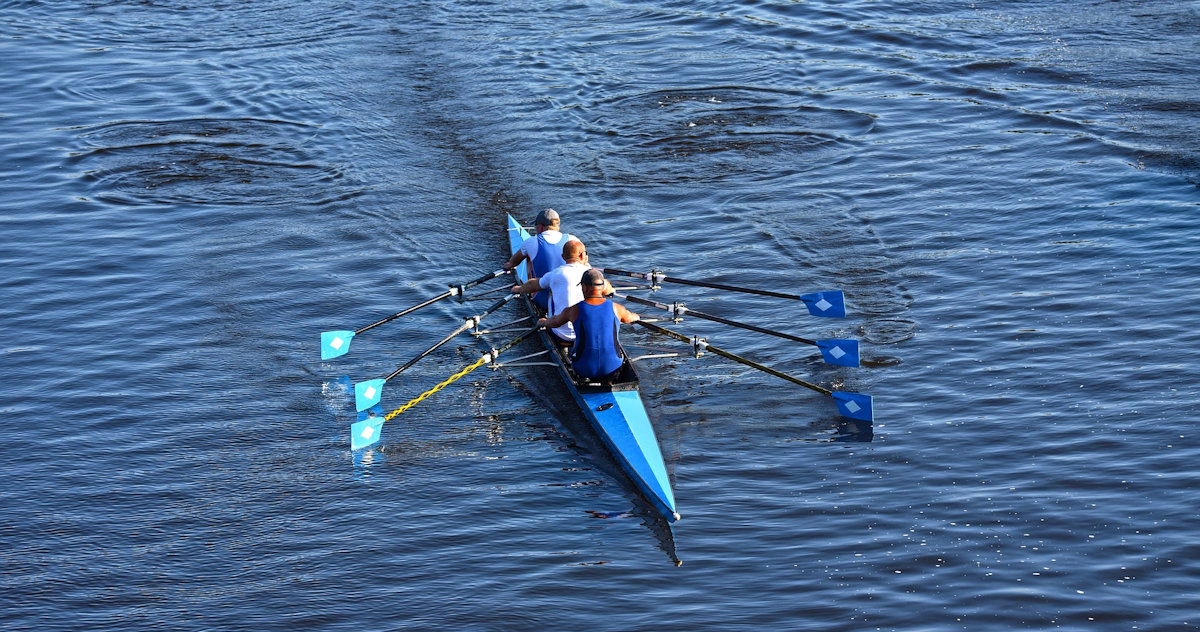
Benefits of Rowing and Canoeing Strength Training
- Leg presses develop quadriceps, gluteal and other lower-body strength that may complement the leg-drive demands of conventional rowing.
- Leg extensions provide targeted quadriceps strengthening when performed with appropriate resistance and technique.
- Abdominal exercises help develop trunk strength and stability during controlled movement.
- Seated rows strengthen upper-back and arm muscles involved in pulling movements.
- Lat pulldowns develop upper-body pulling strength and general back conditioning.
- Shoulder presses and bench presses provide additional upper-body strength training.
- Bicep curls and tricep extensions strengthen muscles involved in elbow movement.
- Wrist curls develop forearm muscles involved in wrist movement and gripping activities.
Rowing and Canoeing Training Precautions
- Begin workouts with an appropriate warm-up before resistance training, rowing or paddling.
- During seated rows and lat pulldowns, maintain controlled movement and avoid excessive rounding or arching of the back.
- During leg presses, use manageable resistance and avoid allowing the lower back to round.
- During leg extensions, avoid forcefully locking the knees or using uncontrolled movements.
- During shoulder presses and bench presses, maintain appropriate shoulder, elbow and wrist alignment.
- Avoid excessive resistance or uncomfortable wrist positions during wrist curls.
- Increase rowing distance, paddling duration and training intensity gradually to avoid excessive repetitive loading.
- Stop or modify activities that produce pain, particularly in the lower back, shoulders, elbows or wrists.
- Wear an appropriately fitted personal flotation device as required or recommended for the activity and conditions, and follow applicable boating safety regulations.
- Check weather, water conditions and boating hazards before entering the water. Beginners should receive appropriate instruction and supervision.
Developing a Rowing and Canoeing Conditioning Program
A balanced rowing or canoeing conditioning program may include muscular strength, cardiovascular endurance, trunk stability, mobility and appropriate recovery. Training should reflect the specific demands of the activity.
Rowers may emphasize lower-body strength, coordinated leg drive and upper-body pulling endurance. Canoeists may place additional emphasis on trunk control, shoulder conditioning and repeated paddling movements.
Resistance training should complement proper rowing or paddling technique. Appropriate practice on the water or supervised training equipment can help participants develop coordination, timing and efficient movement.
Beginners should emphasize correct exercise technique, manageable resistance and gradual progression. Training volume should be adjusted to allow recovery between demanding sessions.
General strength exercises can support physical conditioning but do not replace instruction in boat handling, rowing or paddling mechanics, water safety or emergency procedures.
For additional exercises and conditioning information, visit the Sports-Specific Training Exercises library.
|