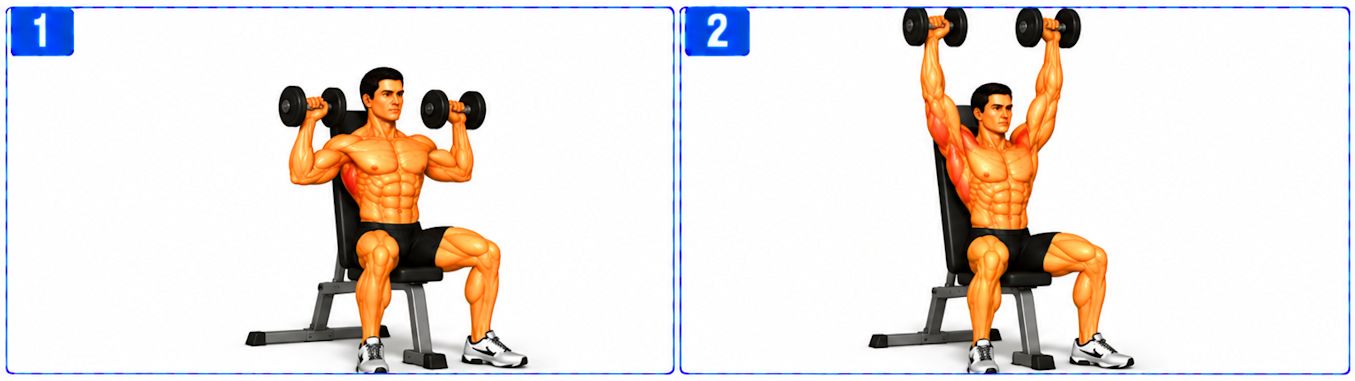
Seated Dumbbell Shoulder Press
TARGET MUSCLES:
- Anterior deltoid: Front shoulder muscle that contributes significantly to raising the arms overhead.
- Middle deltoid: Side shoulder muscle that assists with lifting the upper arms during the pressing movement.
- Triceps brachii: Muscle at the back of the upper arm that extends the elbows as the dumbbells are pressed upward.
- Supraspinatus: Rotator cuff muscle that assists with shoulder abduction and joint stabilization.
- Serratus anterior and trapezius: Muscles that assist with upward rotation and stabilization of the shoulder blades during overhead movement.
START POSITION:
- Sit upright on a bench with a backrest, keeping the back comfortably supported and the feet firmly on the floor.
- Hold a dumbbell in each hand at approximately shoulder height.
- Bend the elbows approximately 90 degrees, with the upper arms extending outward to the sides and the palms facing forward, away from the body.
- Keep the wrists aligned with the forearms and maintain a neutral spine.
- Engage the abdominal muscles to stabilize the torso throughout the exercise.
PROCEDURE:
- Exhale as you press both dumbbells upward in a controlled motion, extending the elbows and raising the weights overhead.
- Allow the arms to move naturally upward without forcing the dumbbells together or excessively shrugging the shoulders.
- Extend the arms through a comfortable range of motion without forcefully locking the elbows.
- Keep the back supported against the bench and avoid excessively arching the lower back.
- Inhale as you slowly lower the dumbbells to approximately shoulder height, returning to the starting position under control.
- Repeat using slow, controlled movements.
NOTES:
- Precaution: Avoid using weights that cause excessive arching of the lower back or loss of control during the overhead press.
- Precaution: Do not lower the elbows or dumbbells beyond a comfortable shoulder range of motion.
- Precaution: Keep the wrists aligned with the forearms and avoid allowing the dumbbells to drift excessively backward.
- Precaution: Use appropriate assistance when positioning or removing heavy dumbbells, and avoid dropping the weights at the end of the exercise.
- Beginner variation: Use lighter dumbbells or a neutral grip, with the palms facing inward, if this provides a more comfortable shoulder position.
- Advanced variation: Increase resistance gradually while maintaining controlled movement and proper shoulder alignment.
|
|