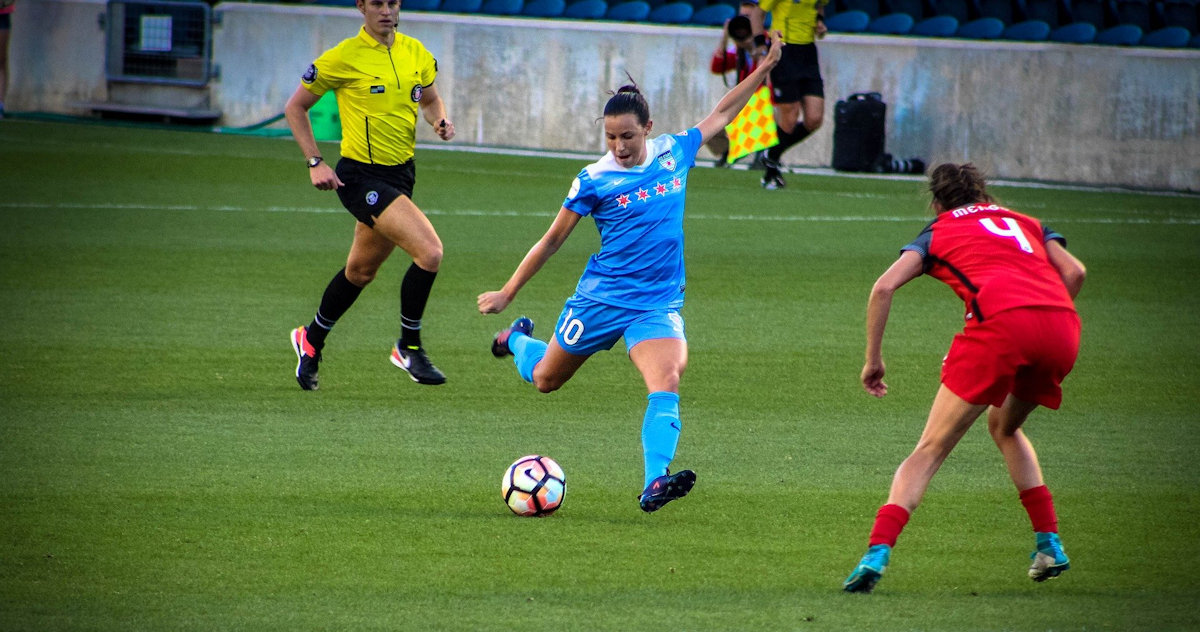
Benefits of Soccer Strength Training
- Squats develop quadriceps, gluteal and other lower-body strength involved in running, jumping and changing direction.
- Leg curls strengthen the hamstrings, which contribute to knee movement and control during athletic activities.
- Leg extensions provide targeted quadriceps strengthening when performed with appropriate resistance and technique.
- Calf raises strengthen lower-leg muscles involved in ankle movement and push-off activities.
- Abdominal exercises help develop trunk strength and stability during coordinated movement.
- Back extensions strengthen muscles involved in supporting the trunk and maintaining posture.
- Lat pulldowns and seated rows develop upper-back and arm strength.
- Shoulder presses, inclined flyes, bicep curls and tricep pushdowns provide additional upper-body conditioning.
Soccer Training Precautions
- Begin each workout or soccer session with an appropriate warm-up before strenuous activity.
- During squats, maintain controlled movement and keep the knees aligned with the feet.
- During leg curls and leg extensions, use manageable resistance and avoid uncontrolled movements or forcefully locking the knees.
- During calf raises, maintain balance and avoid excessive ankle movement or uncomfortable positions.
- During abdominal and back exercises, maintain controlled spinal movement and avoid excessive arching or straining.
- During upper-body exercises, maintain appropriate shoulder, elbow and wrist alignment.
- Increase running distance, sprinting intensity, jumping volume and resistance training gradually.
- Allow adequate recovery between demanding practices, matches and strength-training sessions.
- Use properly fitted footwear appropriate for the playing surface and inspect the field for hazards.
- Avoid excessive contact and follow the rules of the sport. Any suspected concussion requires immediate removal from play and medical evaluation before returning.
- Stop or modify activities that produce pain, dizziness or unusual discomfort. Persistent symptoms should be evaluated by a qualified healthcare professional.
Developing a Soccer Conditioning Program
A balanced soccer conditioning program may include lower-body strength, trunk stability, cardiovascular endurance, speed, agility, mobility and appropriate recovery.
Lower-body resistance exercises may be complemented by appropriately progressed sprinting, acceleration, deceleration and change-of-direction drills. These activities can help players practice movement patterns commonly encountered during soccer.
Aerobic conditioning is also important because soccer involves repeated periods of running and movement throughout a match. Training should reflect the player's experience, playing position and competitive level.
Beginners should emphasize correct exercise technique, manageable resistance and gradual progression. Younger players should receive age-appropriate instruction and supervision during resistance training.
Strength training can support general physical conditioning but does not replace instruction in passing, shooting, dribbling, ball control or tactical skills.
For additional exercises and conditioning information, visit the Sports-Specific Training Exercises library.
|