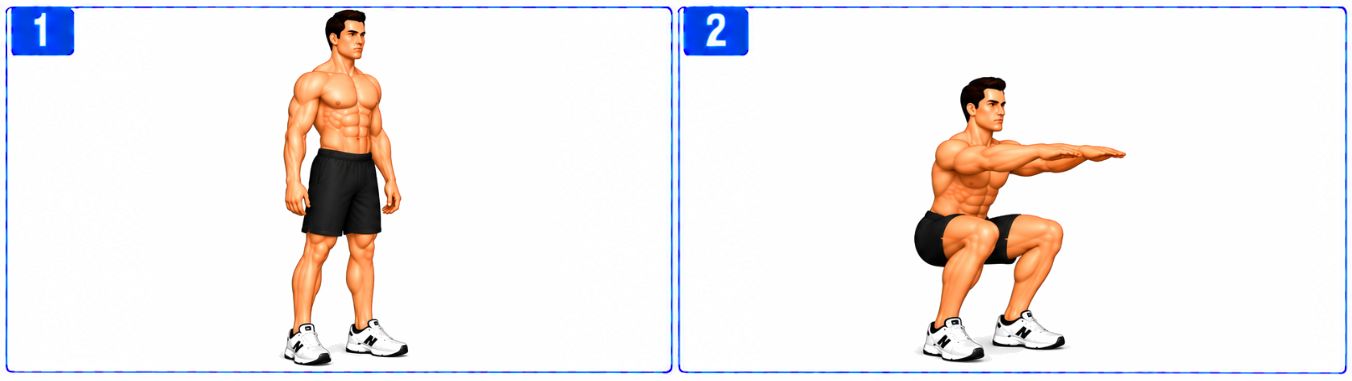
Basic Squat
TARGET MUSCLES:
- Quadriceps: Muscles at the front of the thighs that extend the knees as the body rises from the squat.
- Gluteus maximus: Buttock muscle primarily responsible for extending the hips during the upward movement.
- Adductor magnus: Inner thigh muscle that assists with hip extension and stabilization.
- Hamstrings: Muscles at the back of the thighs that assist with hip stabilization and extension.
- Abdominal and spinal erector muscles: Help stabilize the torso and maintain proper spinal alignment.
START POSITION:
- Stand upright with the feet approximately shoulder-width apart and the toes pointing slightly outward or in a comfortable natural position.
- Keep both arms relaxed at the sides of the body, as illustrated.
- Maintain a neutral spine, keep the chest comfortably lifted and engage the abdominal muscles.
- Distribute body weight evenly across the feet while maintaining balance.
PROCEDURE:
- Inhale as you bend the hips and knees, lowering the body into a squat in a slow, controlled motion.
- As the body descends, extend both arms straight forward to approximately shoulder height to assist with balance.
- Allow the knees to move in the same general direction as the toes while keeping the feet firmly planted on the floor.
- Maintain a neutral spine and lower the hips through a comfortable range of motion without losing balance or control.
- Exhale as you press through the feet and extend the hips and knees to return to the standing position.
- Lower the arms naturally to the sides as you return to the starting position.
- Repeat using slow, controlled movements.
NOTES:
- Precaution: Avoid allowing the knees to collapse inward or the heels to lift excessively during the squat.
- Precaution: Do not force a squat depth that causes discomfort, loss of balance or excessive rounding of the lower back.
- Precaution: Keep the movement controlled and avoid bouncing at the bottom of the squat.
- Beginner variation: Perform a chair squat, lowering toward a stable chair or bench before returning to standing.
- Advanced variation: Progress to a goblet squat using a dumbbell held securely in front of the chest.
|
|