|
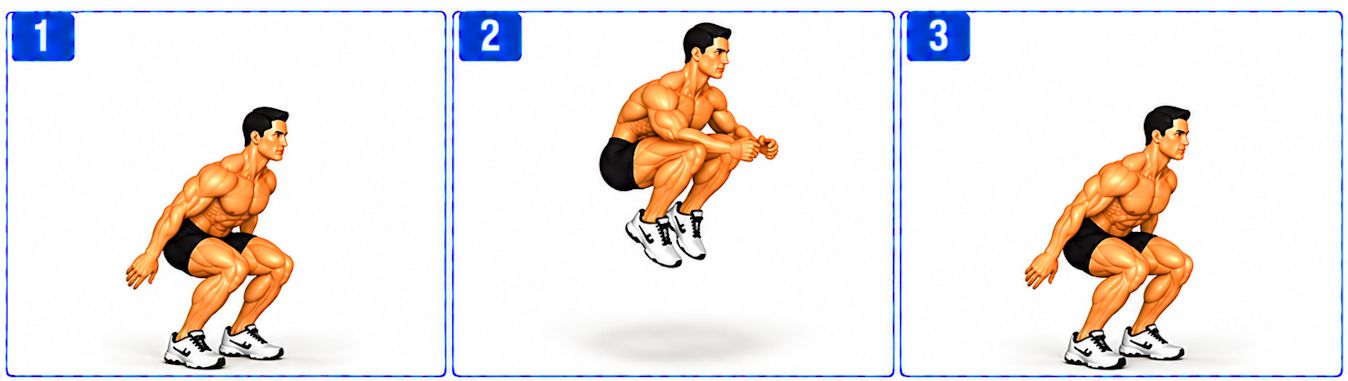
Tuck jumps are an advanced plyometric exercise that develops explosive lower-body power, coordination and cardiovascular conditioning. The movement involves jumping vertically, drawing both knees upward toward the chest while airborne, and landing with control. Tuck jumps engage the major muscles of the lower body while requiring core stabilization and coordinated hip flexion.
TARGET MUSCLES:
- Quadriceps: Extend the knees during takeoff and help control knee bending during landing.
- Gluteus maximus: Produces hip extension during the explosive upward jump and assists with landing control.
- Hamstrings: Assist hip extension during takeoff and contribute to lower-body stabilization.
- Calves (gastrocnemius and soleus): Assist with ankle plantar flexion during takeoff and help absorb landing forces.
- Hip flexors (iliopsoas and rectus femoris): Lift the thighs toward the torso during the airborne knee tuck.
- Abdominal and core muscles: Stabilize the trunk and pelvis throughout the jumping and landing movements.
START POSITION:
- Stand upright with the feet approximately shoulder-width apart and the knees slightly relaxed.
- Keep the head up, shoulders relaxed and abdominal muscles engaged.
- Position the arms naturally at the sides, allowing them to assist with balance and upward momentum.
- Maintain an upright posture and prepare to jump vertically from both feet.
PROCEDURE:
- Bend the hips and knees slightly to prepare for the jump while keeping the spine in a neutral position.
- Push forcefully through both legs, extending the hips, knees and ankles to jump vertically off the floor.
- While airborne, bend the hips and knees to draw both knees upward toward the chest without excessively rounding the back.
- Use the arms naturally to assist with balance and coordination during the jump.
- Extend the legs downward before landing to prepare for contact with the floor.
- Land softly on both feet, bending the hips, knees and ankles to absorb the impact while maintaining proper knee alignment.
- Regain balance and repeat using controlled movements, allowing sufficient recovery between jumps.
NOTES:
- Precaution: Tuck jumps are a high-impact, advanced plyometric exercise and may not be appropriate for individuals with knee, ankle, hip, lower-back or balance limitations.
- Precaution: Avoid landing with stiff knees, allowing the knees to collapse inward or sacrificing landing control to achieve greater jump height.
- Precaution: Do not force the knees toward the chest beyond a comfortable range of motion. Use a stable, nonslip exercise surface and stop if pain or dizziness occurs.
- Beginner variation: Practice controlled vertical jumps without the knee tuck, focusing on balanced takeoff and soft landings.
- Advanced variation: Progress to a series of consecutive tuck jumps with minimal pause between repetitions while maintaining consistent jump height and landing mechanics.
|