Transverse Abduction
TARGET MUSCLES:
- Posterior deltoid: Rear shoulder muscle primarily responsible for moving the upper arms outward and backward during transverse abduction.
- Infraspinatus and teres minor: Rotator cuff muscles that assist with horizontal shoulder abduction and stabilization.
- Middle trapezius: Upper back muscle that retracts the shoulder blades as the arms move outward.
- Rhomboids: Upper back muscles that assist with drawing the shoulder blades together.
START POSITION:
- Stand upright with the feet approximately shoulder-width apart and the knees relaxed.
- Extend both arms straight forward at approximately shoulder height, with the hands gently closed into fists.
- Keep the shoulders relaxed and maintain a neutral spine.
- Engage the abdominal muscles to stabilize the torso throughout the movement.
PROCEDURE:
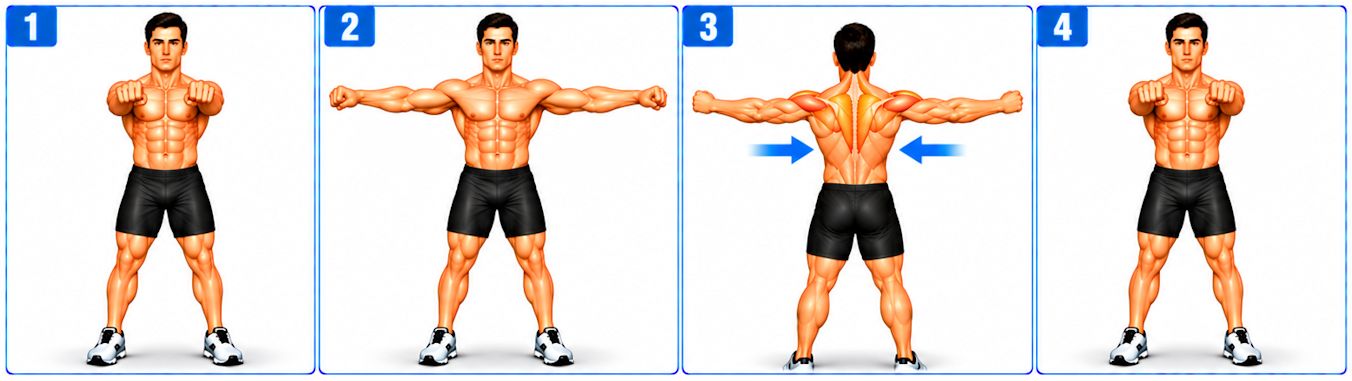
- Step 1: Begin with both arms extended straight forward at shoulder height, as illustrated.
- Step 2: Slowly move both arms outward to the sides in a horizontal arc, keeping them approximately at shoulder height.
- Step 3: Gently squeeze the shoulder blades together, emphasizing contraction of the upper back muscles without shrugging the shoulders or arching the lower back.
- Step 4: Slowly bring both arms forward to the original starting position, allowing the shoulder blades to return naturally.
- Repeat using slow, controlled movements.
NOTES:
- Precaution: Avoid forcing the arms excessively backward or moving beyond a comfortable shoulder range of motion.
- Precaution: Do not shrug the shoulders, arch the lower back or use rapid, jerking movements.
- Beginner variation: Perform the movement with the elbows slightly bent or the arms positioned somewhat below shoulder height if this is more comfortable.
- Advanced variation: Use a light resistance band held between the hands to provide resistance as the arms move outward, while maintaining controlled shoulder movement.
|
|