|
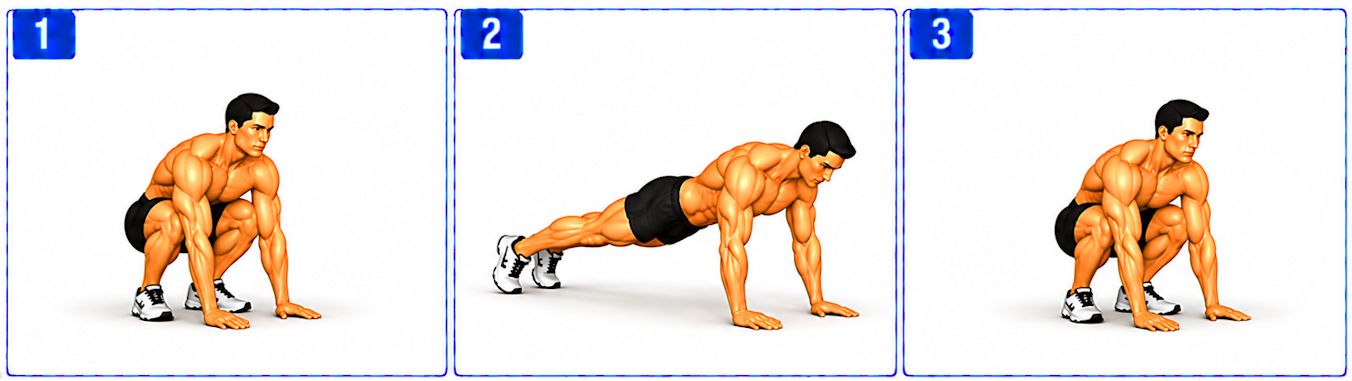
Squat thrusts are a dynamic, full-body conditioning exercise that combines squatting, core stabilization and rapid lower-body movement. The exercise involves lowering into a squat, placing the hands on the floor, extending both legs backward into a plank position, and returning the feet toward the hands before standing. Squat thrusts develop muscular endurance, coordination and cardiovascular conditioning without requiring exercise equipment.
TARGET MUSCLES:
- Quadriceps: Assist with bending and extending the knees during the squat and standing phases.
- Gluteus maximus: Produces hip extension when returning to standing and assists with lower-body stabilization.
- Hamstrings: Assist hip extension and contribute to control of the hips and knees during transitions.
- Hip flexors: Assist with bringing the legs forward from the plank position toward the squat.
- Abdominal and core muscles: Stabilize the spine and pelvis while maintaining proper body alignment in the plank position.
- Deltoids and pectoralis major: Assist with supporting the upper body while the hands remain on the floor.
- Triceps brachii: Help maintain elbow extension and support the arms during the plank phase.
- Calves (gastrocnemius and soleus): Assist with ankle movement and stabilization during the lower-body transitions.
START POSITION:
- Stand upright with the feet approximately shoulder-width apart.
- Keep the head up, shoulders relaxed and abdominal muscles engaged.
- Maintain a neutral spine with the arms resting naturally at the sides.
- Prepare to bend the hips and knees and lower the body toward the floor.
PROCEDURE:
- Bend the hips and knees to lower the body into a squat position.
- Place both hands on the floor approximately shoulder-width apart, slightly in front of the feet.
- Transfer sufficient weight onto the hands and extend both legs backward into a straight-body plank position.
- Maintain a neutral spine with the abdominal muscles engaged, avoiding excessive sagging or arching of the lower back.
- Bring both feet forward toward the hands, returning to a crouched squat position.
- Lift the hands from the floor and extend the hips and knees to return to an upright standing position.
- Repeat the movement at a controlled pace, maintaining proper alignment throughout each transition.
NOTES:
- Precaution: Avoid excessive rounding or arching of the lower back, particularly when moving between the squat and plank positions.
- Precaution: Individuals with wrist, shoulder, knee or lower-back limitations may need a modified version of this exercise.
- Precaution: Use a stable, nonslip surface and avoid moving so quickly that balance or proper technique is compromised. Stop if pain or dizziness occurs.
- Beginner variation: Step one foot backward at a time into the plank position, then step forward to return to the squat. An elevated, stable support may reduce the need to reach the floor.
- Advanced variation: Increase the pace of the squat-to-plank transitions while maintaining controlled movement and proper body alignment.
- Training suggestion: Use short intervals with adequate recovery, emphasizing consistent technique before increasing speed or duration.
|