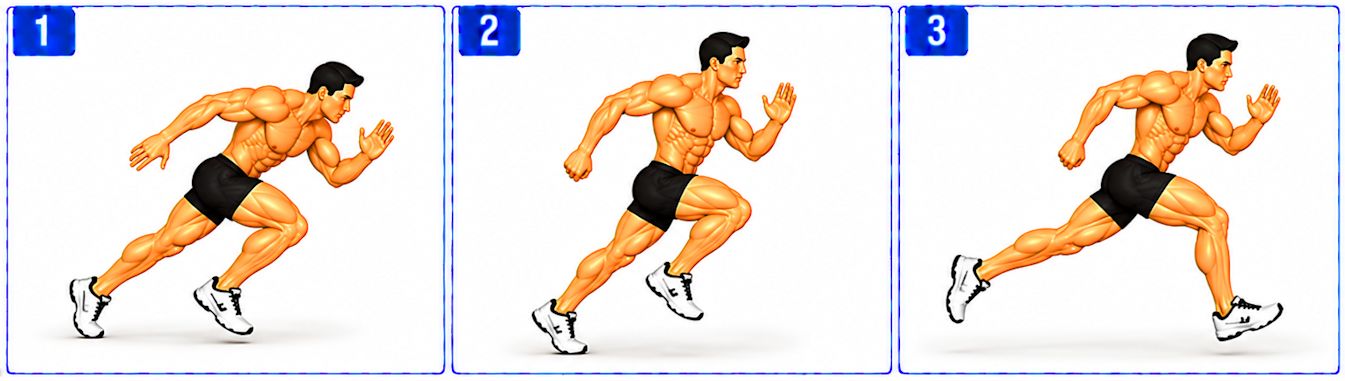
|
Sprints are high-intensity running exercises performed over relatively short distances at fast speeds. Sprint training develops acceleration, running speed, explosive lower-body power and anaerobic conditioning. The movement requires coordinated action of the legs, arms and core muscles to generate forward momentum while maintaining efficient running mechanics.
TARGET MUSCLES:
- Gluteus maximus: Produces powerful hip extension during the propulsive phase of sprinting, particularly during acceleration.
- Quadriceps: Assist with knee extension during propulsion and help support the leg during ground contact.
- Hamstrings: Assist hip extension, flex the knee during leg recovery and help control the forward movement of the lower leg before foot contact.
- Hip flexors (iliopsoas and rectus femoris): Drive the thigh forward during the recovery phase of each stride.
- Calves (gastrocnemius and soleus): Contribute to ankle plantar flexion and force production during ground contact and push-off.
- Gluteus medius and minimus: Help stabilize the pelvis during alternating single-leg support.
- Abdominal and core muscles: Stabilize the trunk and pelvis while supporting efficient transfer of force during running.
- Shoulder and upper-arm muscles: Coordinate the arm swing to assist balance, rhythm and forward running mechanics.
START POSITION:
- Stand upright with the feet approximately hip-width apart on a level, unobstructed running surface.
- Place one foot slightly ahead of the other and bend the hips and knees into a comfortable athletic stance.
- Lean the body slightly forward from the ankles while maintaining a neutral spine.
- Bend the elbows approximately 90 degrees and position the arms opposite the corresponding legs.
- Keep the head aligned with the spine, eyes directed forward and abdominal muscles engaged.
PROCEDURE:
- Push forcefully against the ground with the legs to initiate forward acceleration.
- Drive one knee forward while extending the opposite hip and leg to propel the body ahead.
- Swing the arms forward and backward in coordination with the opposite legs, keeping the elbows comfortably bent.
- Gradually increase stride frequency and speed while maintaining a controlled forward body lean during acceleration.
- As running speed increases, allow the torso to become more upright without leaning backward or excessively arching the lower back.
- Maintain quick, controlled foot contacts beneath or near the body's center of mass, avoiding excessive reaching with the leading foot.
- Continue sprinting for the planned distance or interval while maintaining coordinated arm and leg movements.
- After completing the sprint, gradually reduce running speed and transition to a walk rather than stopping abruptly.
NOTES:
- Precaution: Sprinting is a high-intensity activity that places substantial demands on the muscles, joints and cardiovascular system. Individuals with relevant medical conditions or injuries should obtain appropriate professional guidance before beginning.
- Precaution: Perform a progressive warm-up before sprinting, including light jogging, dynamic mobility exercises and gradual acceleration drills.
- Precaution: Use appropriate footwear and a stable running surface. Avoid sudden maximal-effort sprints without adequate preparation, and stop if pain, dizziness or unusual symptoms occur.
- Beginner variation: Begin with short, controlled accelerations or faster running intervals at a submaximal effort, gradually increasing speed as technique and conditioning improve.
- Advanced variation: Perform repeated short-distance sprints with planned recovery intervals, emphasizing acceleration, running mechanics and consistent speed.
- Training suggestion: Allow sufficient recovery between high-intensity sprints to maintain running quality and reduce fatigue-related changes in technique.
|