|
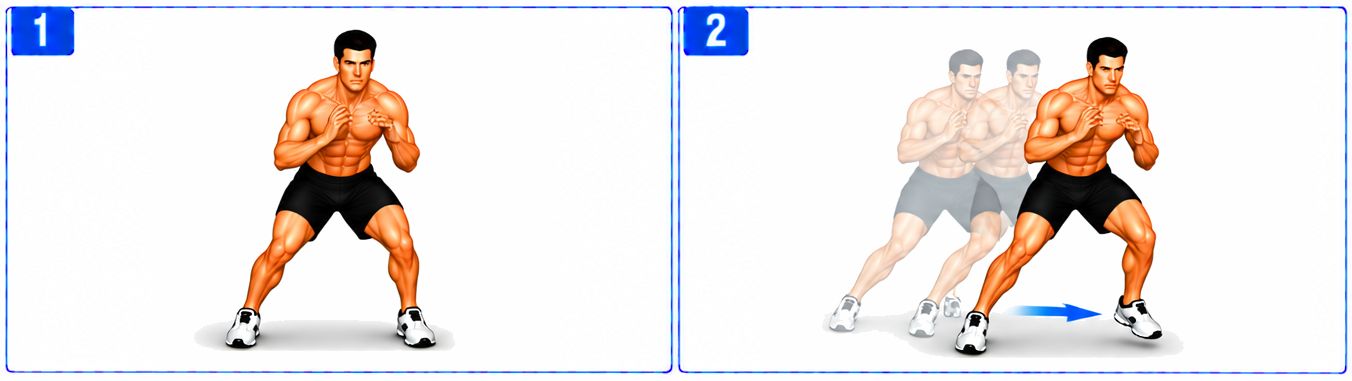
Side shuffles are a lateral agility exercise that develops coordination, balance and lower-body conditioning. The movement involves stepping sideways while maintaining a slightly lowered athletic stance and keeping the feet from crossing. Side shuffles engage the hip abductors, hip adductors, quadriceps, gluteals and calf muscles while improving the ability to move efficiently in either direction.
TARGET MUSCLES:
- Gluteus medius and minimus: Assist with hip abduction and stabilize the pelvis during lateral movement.
- Hip adductors: Help draw the legs toward the midline and control lateral stepping movements.
- Quadriceps: Support the bent-knee athletic stance and assist with leg extension during lateral push-off.
- Gluteus maximus: Assists hip extension and stabilizes the lower body during directional movement.
- Hamstrings: Assist with hip and knee control throughout the exercise.
- Calves (gastrocnemius and soleus): Assist with lateral push-off, foot positioning and balance.
- Abdominal and core muscles: Stabilize the trunk while the body moves sideways.
START POSITION:
- Stand with the feet approximately shoulder-width apart and the knees slightly bent.
- Lower the hips into a comfortable athletic stance while keeping the chest lifted and the spine neutral.
- Keep the head up, eyes forward and abdominal muscles engaged.
- Bend the elbows and position the arms naturally in front of the body to assist with balance.
- Maintain balanced weight distribution and prepare to move laterally in either direction.
PROCEDURE:
- Push off with the foot opposite the intended direction of travel and step sideways with the leading foot.
- Bring the trailing foot toward the leading foot while maintaining a comfortable distance between the feet.
- Continue stepping sideways in a smooth, controlled rhythm without crossing the legs.
- Maintain a slightly bent-knee athletic stance, keeping the hips lowered and the torso stable.
- Use small, coordinated arm movements to assist with balance and lateral momentum.
- After traveling the desired distance, slow down under control and reverse direction.
- Repeat the movement in both directions, gradually increasing speed as coordination and control improve.
NOTES:
- Precaution: Avoid crossing the feet, allowing the knees to collapse inward or taking steps so large that balance is compromised.
- Precaution: Use a stable, nonslip exercise surface with adequate lateral space and remain aware of nearby obstacles.
- Precaution: Reduce speed or stop if pain, dizziness or loss of balance occurs.
- Beginner variation: Perform slow lateral steps with a more upright stance before progressing to continuous shuffling.
- Advanced variation: Increase lateral speed or incorporate controlled changes of direction over short distances.
- Training suggestion: Use floor markers or cones to establish a consistent distance for each direction.
|