|
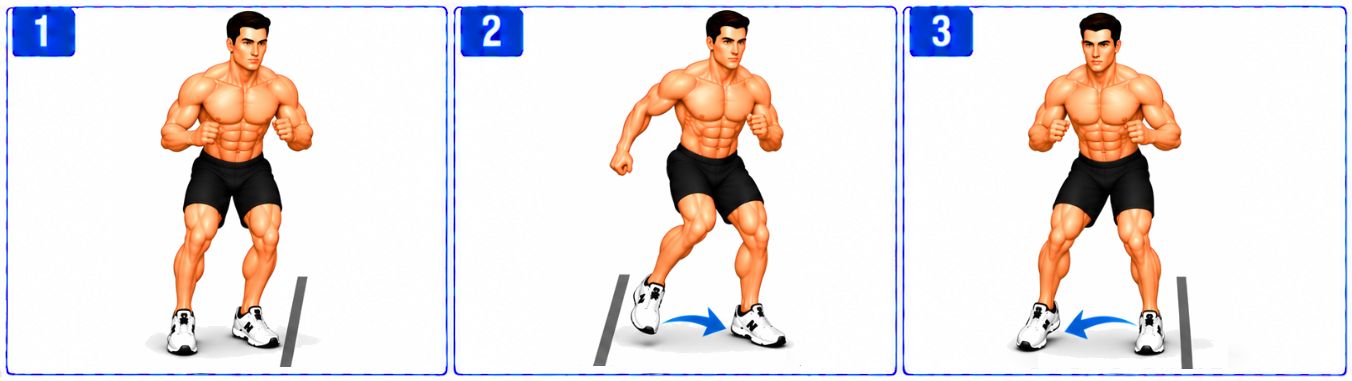
Side-to-side hops are a lateral plyometric exercise that develops lower-body coordination, agility, balance and cardiovascular conditioning. The movement involves hopping sideways over a line or floor marker with both feet together, then reversing direction. Repeated lateral hops engage the leg and hip muscles while challenging the body's ability to absorb landing forces and quickly change direction.
TARGET MUSCLES:
- Quadriceps: Extend the knees during takeoff and help control knee flexion during landing.
- Gluteus maximus: Assists hip extension during jumping and helps stabilize the lower body.
- Gluteus medius and minimus: Assist with lateral hip control and pelvic stabilization during side-to-side movement.
- Hip adductors: Contribute to lateral movement control and stabilization of the legs.
- Hamstrings: Assist hip extension and help stabilize the knees during jumping and landing.
- Calves (gastrocnemius and soleus): Assist with ankle plantar flexion during takeoff and help control landing forces.
- Abdominal and core muscles: Stabilize the trunk and help maintain balance during rapid lateral movements.
START POSITION:
- Stand beside a line or flat floor marker with both feet together or approximately hip-width apart.
- Keep the knees slightly bent and the weight balanced over the feet.
- Maintain an upright torso with the abdominal muscles engaged and the shoulders relaxed.
- Bend the elbows and position the arms naturally to assist with balance.
- Prepare to jump laterally across the line using both feet simultaneously.
PROCEDURE:
- Bend the hips and knees slightly to prepare for the lateral hop.
- Push off with both feet and hop sideways over the line or floor marker.
- Land on both feet on the opposite side, bending the hips, knees and ankles to absorb the impact.
- Keep the knees aligned with the direction of the toes and maintain a stable torso.
- Push off again and hop back across the line in the opposite direction.
- Continue alternating from side to side using small, controlled hops.
- Gradually increase the pace as coordination, balance and landing control improve.
NOTES:
- Precaution: Avoid landing with stiff knees, allowing the knees to collapse inward or using excessively wide hops that compromise balance.
- Precaution: Use a flat, nonslip surface and a floor marking that does not create a tripping hazard.
- Precaution: Individuals with certain ankle, knee, hip or balance limitations may need a lower-impact alternative. Stop if pain or dizziness occurs.
- Beginner variation: Step sideways over the line with one foot at a time, then bring the other foot across without jumping.
- Advanced variation: Increase the speed or lateral distance of the hops while maintaining soft, controlled landings.
- Training suggestion: Use short timed intervals with adequate recovery to emphasize quick footwork and consistent technique.
|