|
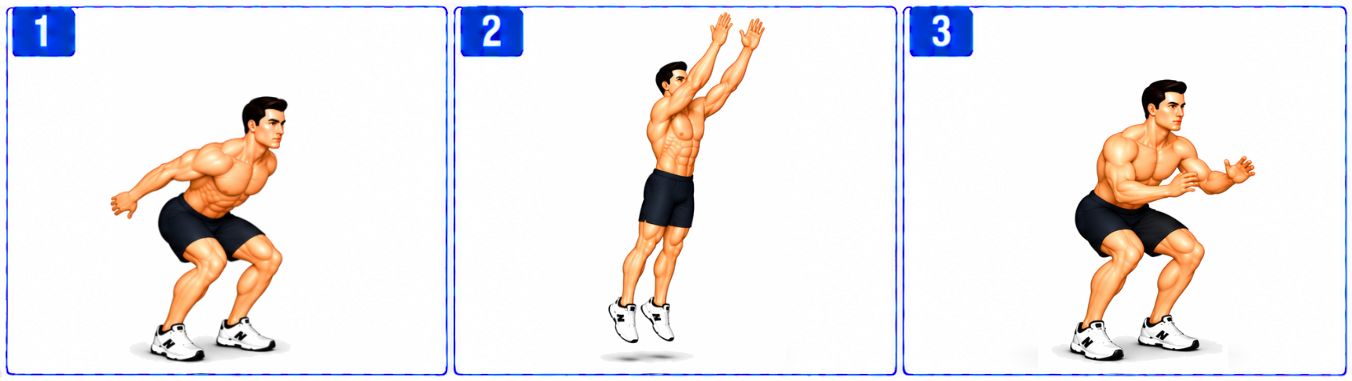
Plyometric training uses rapid, explosive movements to develop muscular power, coordination and athletic performance. These exercises typically involve a rapid muscle-lengthening phase followed by a powerful muscle-shortening contraction, known as the stretch-shortening cycle. The illustrated squat-based jump demonstrates this principle by combining a preparatory squat and arm swing with an explosive upward jump and controlled two-foot landing.
TARGET MUSCLES:
- Quadriceps: Extend the knees during takeoff and help control knee flexion during landing.
- Gluteus maximus: Produces powerful hip extension during the upward jumping movement.
- Hamstrings: Assist hip extension and contribute to stabilization of the hips and knees.
- Calves (gastrocnemius and soleus): Assist with ankle plantar flexion during takeoff and help absorb landing forces.
- Gluteus medius and minimus: Help stabilize the pelvis and maintain proper alignment of the lower extremities.
- Abdominal and core muscles: Stabilize the trunk and support balance during jumping and landing.
- Deltoids and shoulder muscles: Assist the coordinated arm swing used to generate upward momentum.
START POSITION:
- Stand upright with the feet approximately shoulder-width apart and the toes pointing forward or slightly outward.
- Keep the head up, shoulders relaxed and abdominal muscles engaged.
- Position the arms naturally at the sides and maintain a neutral spine.
- Prepare to lower into a squat while swinging the arms backward to assist with the explosive jump.
PROCEDURE:
- Bend the hips and knees to lower the body into a comfortable squat position while swinging both arms backward.
- Maintain a neutral spine and keep the knees aligned with the direction of the toes.
- Immediately push forcefully through both legs, extending the hips, knees and ankles to jump upward.
- Swing both arms forward and upward to assist with momentum as the body rises into the air.
- Extend the body upward and outward during the airborne phase while maintaining balance and control.
- Prepare for landing by bringing the arms into a balanced position and positioning both feet beneath the body.
- Land softly on both feet, bending the hips, knees and ankles to absorb the impact.
- Regain balance before repeating the movement, maintaining controlled takeoff and landing mechanics.
NOTES:
- Precaution: Plyometric jumping exercises are high-impact movements and may not be appropriate for individuals with certain knee, ankle, hip or balance limitations.
- Precaution: Avoid landing with stiff knees, allowing the knees to collapse inward or using a jump height that compromises control.
- Precaution: Perform jumps on a stable, nonslip surface with adequate overhead clearance. Stop if pain, dizziness or loss of balance occurs.
- Beginner variation: Practice bodyweight squats followed by controlled calf raises or low vertical jumps before progressing to more explosive movements.
- Advanced variation: Progress to repeated controlled jumps with shorter ground-contact times while maintaining proper landing mechanics and allowing adequate recovery.
- Training suggestion: Emphasize movement quality, explosive power and adequate recovery rather than performing repetitions to exhaustion.
|