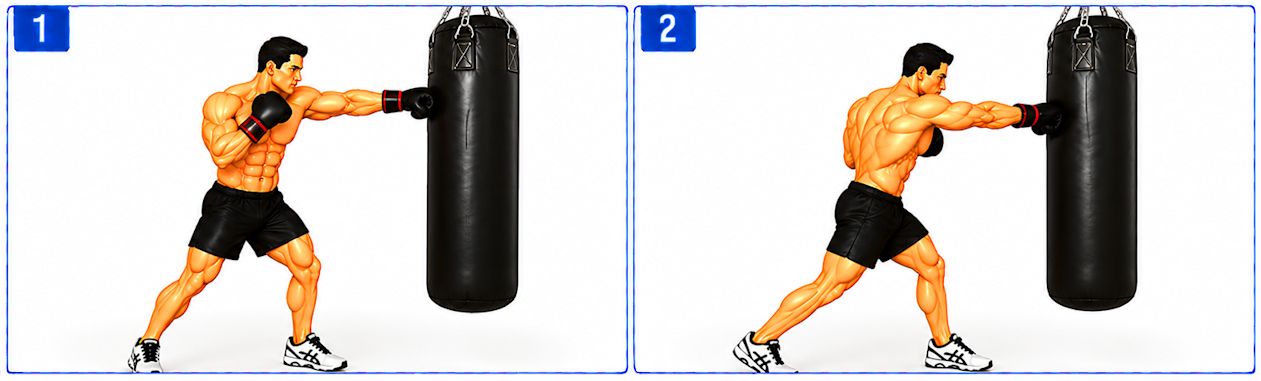
TARGET MUSCLES:
- Pectoralis major: Chest muscle that helps move the upper arm forward and across the body during punching.
- Anterior deltoid: Front shoulder muscle that assists with forward arm movement.
- Triceps brachii: Extends the elbow during straight punches.
- Serratus anterior: Assists with forward movement and stabilization of the shoulder blade during punching.
- Rectus abdominis and obliques: Stabilize the trunk and assist with controlled torso rotation.
- Gluteal and leg muscles: Contribute to balance, stance stability and force transfer during punching.
START POSITION:
- Stand facing a securely suspended heavy bag with feet staggered approximately shoulder-width apart and knees slightly bent.
- Wear appropriate boxing gloves and hand wraps for protection.
- Maintain an upright, balanced stance with the abdominal muscles engaged and shoulders relaxed.
- Extend the left arm toward the bag, placing the left glove lightly against its surface as illustrated.
- Keep the right hand near the face in preparation for the punching movement.
PROCEDURE:
- Withdraw the left glove from the bag and return it toward the face in a defensive guard position.
- From a balanced stance, initiate a controlled right-hand punch toward the heavy bag.
- Allow the hips and torso to rotate naturally with the punching movement while maintaining balance.
- Extend the right arm toward the bag without forcefully locking the elbow, keeping the wrist aligned with the forearm.
- Exhale during the punch and make controlled contact with the bag.
- Retract the right hand promptly to the defensive position while maintaining a stable stance.
- Repeat using controlled movements, then practice alternating punches and combinations as technique improves.
NOTES:
- Precaution: Use properly fitted boxing gloves and hand wraps to help protect the hands and wrists.
- Precaution: Avoid striking with a bent wrist, locking the elbow or using excessive force before proper technique is established.
- Precaution: Keep the head and face clear of the swinging bag, and avoid pushing against it with the extended left arm.
- Precaution: Stop if pain develops in the hands, wrists, elbows or shoulders.
- Beginner variation: Practice light, controlled punches with minimal power while concentrating on balance, hand position and technique.
- Advanced variation: Incorporate combinations, footwork and timed intervals while maintaining proper technique.
HEAVY BAG TRAINING DRILLS
The following drills can be used to develop punching technique, footwork, coordination, muscular endurance and cardiovascular conditioning. Adjust the intensity and duration according to fitness and experience level.
- Move around the bag while punching, coordinating each punch with controlled foot movements. Develop a comfortable rhythm and vary your position to simulate a moving target.
- Execute a controlled right-hand punch while stepping into an appropriate striking distance. Change the angle of attack by moving from side to side while maintaining balance. Repeat the drill using the left hand.
- Execute a right-hand punch while stepping toward the bag, followed by two short, alternating punches. Repeat the combination beginning with the left hand.
- Execute a controlled, progressively stronger left-hand punch while changing the angle of attack between repetitions. Move from side to side, maintaining proper footwork and balance. Repeat using the right hand.
- Practice close-range punches, including body punches and hooks. Maintain a stable stance as the bag moves, vary the target and punch combinations, and return the hands to the defensive position after each punch.
- Practice short intervals of faster, more powerful punches while maintaining proper technique, balance and control. Reduce the intensity whenever punching technique begins to deteriorate.
- Practice speed punching using quick, controlled punches rather than maximum force. Continue for approximately 30 seconds to 1 minute, adjusting the duration according to fitness level.
- Vary punching speed and power while practicing different combinations. Include occasional stronger punches without sacrificing technique. Continue for approximately 2 to 3 minutes, adjusting the duration as appropriate.
- Practice interval training by alternating periods of faster punching with periods of lighter activity or recovery. Adjust the work and recovery intervals according to fitness level, experience and training goals.
|