
|
|
Nutritional Requirements

Daily Caloric Requirements
A pound is equivalent to 3500 calories. To over simplify, if you want to lose one pound per week, reduce your caloric consumption by 3500 calories per week. Consuming less than 1500 calories per day on a regular basis reduces the basal metabolic rate. When the metabolic rate is reduced, less calories can be consumed. Excess calories will be stored as fat. This is why it's important to combine exercise with diet in order to affect weight loss.
Your basal metabolic rate is the basic minimum number of calories that are required to maintain your body weight based on average body composition. To calculate your basal metabolic rate:
Basal Metabolic Rate (BMR) = 24 x Weight (lb)/2.2
OR
Basal Metabolic Rate (BMR) = 24 x Weight (kg)
The BMR is then multiplied by a number representing the individuals activity level:

| Sedentary |
Light |
Medium |
Heavy |
| BMR x 1.45 |
BMR x 1.60 |
BMR x 1.70 |
BMR x 1.88 |
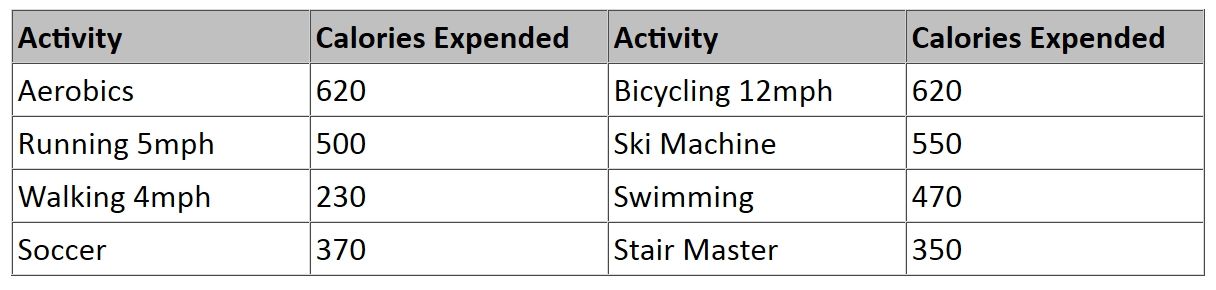
Generally, eating more than this number of calories increases weight and less than this number allows weight reduction. However, BMR does not take into account extremes of activity or inactivity. Therefore, BMR should be used as a approximation. Various activities will increase caloric requirements above the BMR. The following table shows the approximate amount of calories required for a 135-pound individual performing the following listed activity for 1 hour:
| Activity |
Calories Expended |
Activity |
Calories Expended |
| Aerobics |
620 |
Bicycling 12mph |
620 |
| Running 5mph |
500 |
Ski Machine |
550 |
| Walking 4mph |
230 |
Swimming |
470 |
| Soccer |
370 |
Stair Master |
350 |
Protein, Carbohydrate And Fat Dietary Requirements
Proper nutrition requires a balanced intake of Protein, Carbohydrates and Fat. Protein and Carbohydrates are both 4 calories per gram. Fat is 9 calories per gram. An example follows for a daily caloric requirement of 2000 calories. The amount of grams of each will vary according to your daily caloric requirement (based on BMR). However, the percentages should remain the same for all. The following example is for a daily caloric requirement of 2000 calories:
- Protein: (4 cal/g) should be 30% of total calories = 600 cal (protein) = 150g
- Carbohydrates: (4 cal/g) should be 60% of total calories = 1200 cal (carbs) = 300g
- Fat: (9 cal/g) should be 10% of total calories = 200 cal (fat) = 22g
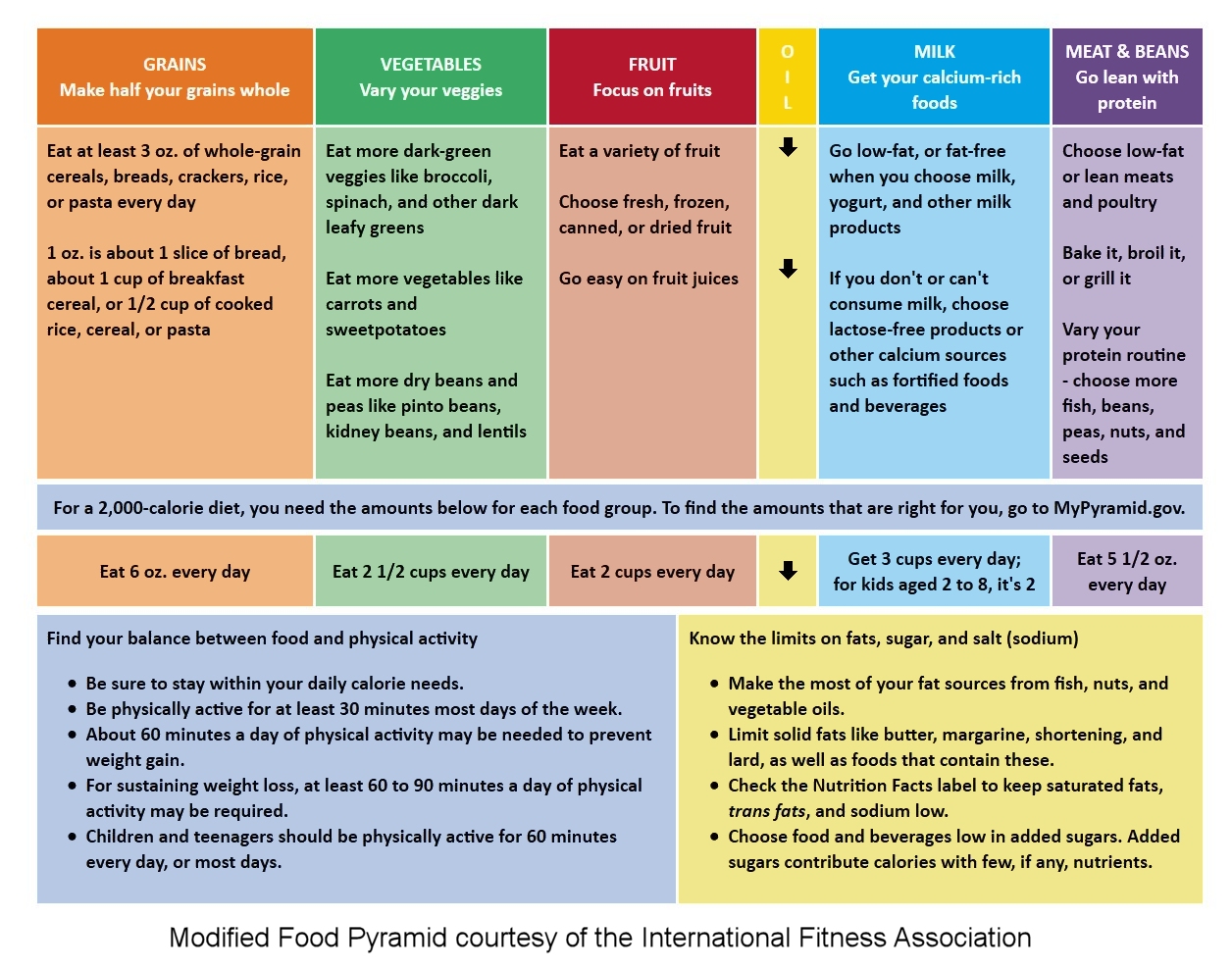
USDA MyPyramid Food Guide Table
GRAINS
Make half your grains whole |
VEGETABLES
Vary your veggies |
FRUIT
Focus on fruits |
O I L
|
MILK
Get your calcium-rich foods |
MEAT & BEANS
Go lean with protein |
Eat at least 3 oz. of whole-grain cereals, breads, crackers, rice, or pasta every day
1 oz. is about 1 slice of bread, about 1 cup of breakfast cereal, or 1/2 cup of cooked rice, cereal, or pasta |
Eat more dark-green veggies like broccoli, spinach, and other dark leafy greens
Eat more vegetables like carrots and sweetpotatoes
Eat more dry beans and peas like pinto beans, kidney beans, and lentils |
Eat a variety of fruit
Choose fresh, frozen, canned, or dried fruit
Go easy on fruit juices |

 |
Go low-fat, or fat-free when you choose milk, yogurt, and other milk products
If you don't or can't consume milk, choose lactose-free products or other calcium sources such as fortified foods and beverages |
Choose low-fat or lean meats and poultry
Bake it, broil it, or grill it
Vary your protein routine - choose more fish, beans, peas, nuts, and seeds |
| For a 2,000-calorie diet, you need the amounts below for each food group. To find the amounts that are right for you, go to MyPyramid.gov. |
Eat 6 oz. every day
|
Eat 2 1/2 cups every day
|
Eat 2 cups every day
|

|
Get 3 cups every day; for kids aged 2 to 8, it's 2
|
Eat 5 1/2 oz. every day
|
Find your balance between food and physical activity
- Be sure to stay within your daily calorie needs.
- Be physically active for at least 30 minutes most days of the week.
- About 60 minutes a day of physical activity may be needed to prevent weight gain.
- For sustaining weight loss, at least 60 to 90 minutes a day of physical activity may be required.
- Children and teenagers should be physically active for 60 minutes every day, or most days.
|
Know the limits on fats, sugar, and salt (sodium)
- Make the most of your fat sources from fish, nuts, and vegetable oils.
- Limit solid fats like butter, margarine, shortening, and lard, as well as foods that contain these.
- Check the Nutrition Facts label to keep saturated fats, trans fats, and sodium low.
- Choose food and beverages low in added sugars. Added sugars contribute calories with few, if any, nutrients.
|
Table from the MyPyramid Food Guide - A guide to daily food choices
© 1995 - 2012 by IFA www.ifafitness.com
|